
Maurizio Scilla and Simone Conzato present «0.4 Fuoco», the new molecular essence of 03 Studio Lab. On Friday, October 30 in Riccione, for Snouf Exclusive, a debut between design, music, tango and olfactory cocktails
There are perfumes that ask for permission. They settle on the skin with discretion, wait to be noticed, almost apologize for being there. And then there are those that enter a room before those who wear them, sit down, cross their legs and decide the tone of the conversation themselves. «0.4 Fuoco», the new creation by Maurizio Scilla and Simone Conzato for 03 Studio Lab, belongs without hesitation to the second kind. It doesn’t create an ante-room. It arrives.
It all starts with a gesture. A dark, rough block that seems to have been torn off the side of a volcano opens in two. And from the black material emerges the red of a round bottle, glowing like a charcoal held in the glass. You look at it and you think of lava stone, the still warm coal, the rock that the fire has crossed and bears the marks of it. Then you take it in your hand and the surprise arrives: it weighs nothing. Because that stone is not stone. It is recycled polystyrene, shaped and finished by the artisans of Artigiana Polistirolo in San Marino until it deceives the eye. The most humble and lightweight material in the world, that which usually ends up in the trash after protecting an electrical appliance, is transformed into an object that has the presence of a monolith. There is some irony in this, and also a lesson: appearance is not a lie when it becomes a narrative.
After all, Scilla and Conzato come from the world of interior design, and that’s obvious. They know that a fragrance begins to speak long before it’s sprayed, that the box is the prologue and the bottle the first chapter. They’ve already experimented with «0.3 Origine,» their previous fragrance, encased in a casing that mimicked natural stone. The method is the same: to seek connections between worlds that normally don’t speak to each other, and to force them to find a common language.
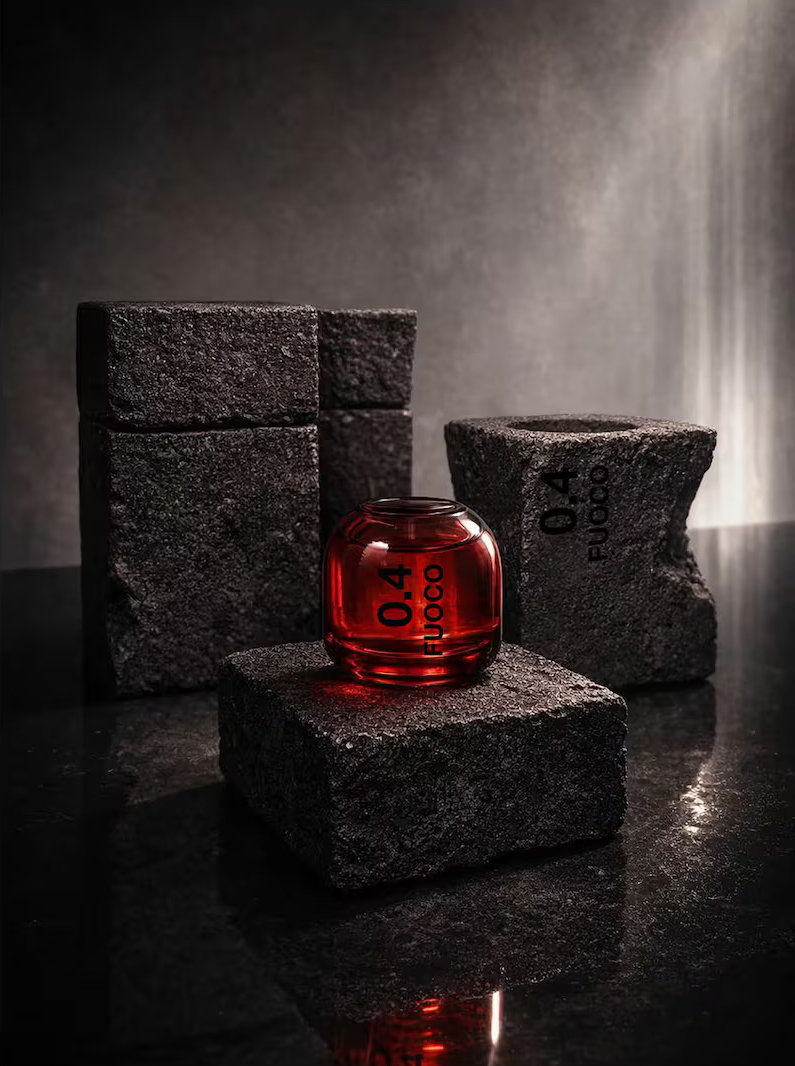
Then, of course, there is the essence. And the subtitle that the two authors have sewn onto it, the essence of instinct, in an age where everything is calculated, filtered, and possibly approved by an algorithm, almost sounds like a provocation. Instinct, that ancient thing that made us turn around in the street without knowing why, here is returned to those who still have the desire to trust their nose more than their head. The departure point is a small gamble: bitter almond and spices. The bitter almond has something literary about it; it smells of a detective novel and of home-baked sweets together, of temptation and of home. In the heart meet vanilla, cedar, and oud: the sweetness that consoles, the wood that supports, and that resinous note, dark, almost nocturnal, that the East has been giving for centuries to those who know how to handle it with judgment. At the end, when the evening has progressed and the words become slower, there remains moss and grey amber. It is there that a scent truly tells who it is: not in the first few minutes, when everyone is putting on a good show, but in the subsequent hours, when only the truth remains.